
 Image 1 of 1
Confident Writer Morning Routine Visual Digital Download
Transform daily transitions and bring calm to your household with child-first visual routine cards. Designed specifically around how young minds learn, every detail—from line weight to color selection—is crafted strictly based on children's developmental needs and understanding.
Visual-First Clarity: Because the human brain processes visual information 60,000 times faster than text or audio, these clear visual cues eliminate non-compliance and reduce anxiety around daily transitions.
Boosts Writing Confidence: Intentionally simple, uncluttered drawings provide accessible shapes that children can easily recognize and copy, building early mark-making and writing confidence.
Peaceful Household Flow: Empowers children with ownership over their day, creating a seamless, cooperative rhythm for both adults and kids.
Product Details:
Format: Instant Printable PDF (Digital Download)
Includes: black and white morning routine cards
Best For: Humans, visuals can support understanding no matter how old, infant, toddler, preschool, middle school, highschool, spouses, and parents
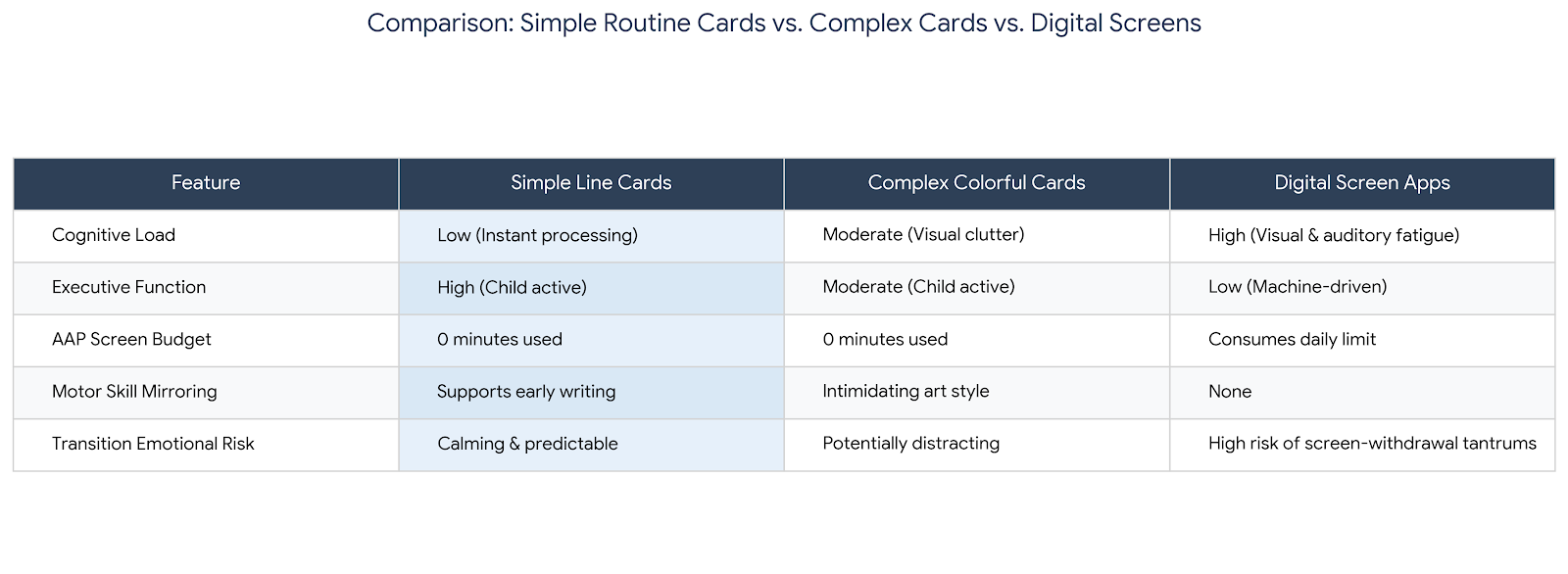
Simple visual cards outperform over-designed graphics and digital screens because they build intrinsic self-regulation rather than triggering passive dopamine responses or visual fatigue.
Simple Line Drawings vs. Over-Designed Graphics
Eliminates Visual Noise: Complex illustrations flood a child's visual cortex with non-essential details—shadows, busy backgrounds, and multiple colors. A child's brain must expend cognitive energy filtering out the extra information just to locate the core task. Simple line drawings deliver instant iconographic recognition without cognitive fatigue.
Builds Pre-Writing Confidence: Hyper-detailed digital art creates an internal barrier; children see art they can never recreate. Minimalist, hand-drawn shapes represent stroke patterns (circles, lines, curves) that children can easily replicate, boosting pre-writing skills and fine motor confidence.
Reduces Sensory Overload: Over-designed visual tools often overstimulate sensitive or neurodivergent children. Clean lines create a calm visual field, promoting a peaceful atmosphere during sensitive transition times.
Physical Cards vs. Digital Screens
Protects Daily Screen Time Budgets: The American Academy of Pediatrics (AAP) recommends zero screen time for children under 18–24 months (except video chatting) and no more than 1 hour per day of high-quality programming for children ages 2 to 5. Using digital routine apps consumes a child's limited screen allowance on mundane daily activities that should be grounded in their physical environment.
Fosters Executive Functioning vs. Machine-Driven Passive Response: Interactive screens, lights, and gamified timers perform the mental heavy lifting for the child. When a device flashes or plays a sound, the machine acts as the brain, training the child to react passively to external stimuli. Physical cards require children to physically move, touch, sequence, and process information, building authentic working memory, spatial awareness, and planning skills.
Transform daily transitions and bring calm to your household with child-first visual routine cards. Designed specifically around how young minds learn, every detail—from line weight to color selection—is crafted strictly based on children's developmental needs and understanding.
Visual-First Clarity: Because the human brain processes visual information 60,000 times faster than text or audio, these clear visual cues eliminate non-compliance and reduce anxiety around daily transitions.
Boosts Writing Confidence: Intentionally simple, uncluttered drawings provide accessible shapes that children can easily recognize and copy, building early mark-making and writing confidence.
Peaceful Household Flow: Empowers children with ownership over their day, creating a seamless, cooperative rhythm for both adults and kids.
Product Details:
Format: Instant Printable PDF (Digital Download)
Includes: black and white morning routine cards
Best For: Humans, visuals can support understanding no matter how old, infant, toddler, preschool, middle school, highschool, spouses, and parents
Simple visual cards outperform over-designed graphics and digital screens because they build intrinsic self-regulation rather than triggering passive dopamine responses or visual fatigue.
Simple Line Drawings vs. Over-Designed Graphics
Eliminates Visual Noise: Complex illustrations flood a child's visual cortex with non-essential details—shadows, busy backgrounds, and multiple colors. A child's brain must expend cognitive energy filtering out the extra information just to locate the core task. Simple line drawings deliver instant iconographic recognition without cognitive fatigue.
Builds Pre-Writing Confidence: Hyper-detailed digital art creates an internal barrier; children see art they can never recreate. Minimalist, hand-drawn shapes represent stroke patterns (circles, lines, curves) that children can easily replicate, boosting pre-writing skills and fine motor confidence.
Reduces Sensory Overload: Over-designed visual tools often overstimulate sensitive or neurodivergent children. Clean lines create a calm visual field, promoting a peaceful atmosphere during sensitive transition times.
Physical Cards vs. Digital Screens
Protects Daily Screen Time Budgets: The American Academy of Pediatrics (AAP) recommends zero screen time for children under 18–24 months (except video chatting) and no more than 1 hour per day of high-quality programming for children ages 2 to 5. Using digital routine apps consumes a child's limited screen allowance on mundane daily activities that should be grounded in their physical environment.
Fosters Executive Functioning vs. Machine-Driven Passive Response: Interactive screens, lights, and gamified timers perform the mental heavy lifting for the child. When a device flashes or plays a sound, the machine acts as the brain, training the child to react passively to external stimuli. Physical cards require children to physically move, touch, sequence, and process information, building authentic working memory, spatial awareness, and planning skills.